Bridging the Gap: Is Robotic Surgery Training Keeping Up with Surgical Innovation?
Developed in collaboration with Professor Jacques Hubert, MD, PhD.
Robot-assisted surgery (RAS) has rapidly moved from science-fiction to standard practice. With more hospitals adopting robotic systems every year, the pressure is on to ensure surgeons gain proficiency quickly, safely, and consistently.
But is training keeping pace with innovation?
Robot-Assisted Surgery Is Growing – Fast
Robot Assisted Surgery (RAS) is now at the very forefront of medical technology. Agile robotic systems and advanced computing, working alongside human expertise and intuition, are enabling safer, faster, and more reliable surgical performance.
Demand for robotic procedures continues to rise. A 2022 review in STEM Journal estimated that more than 1.5 million robotic-assisted surgery procedures were performed globally that year, with strong year-on-year growth.
Since 2022, annual robotic-assisted procedure volumes have more than doubled, reflecting an accelerating upward trajectory in global adoption.
In 2025, surgeons using Intuitive’s da Vinci systems have surpassed 20 million procedures performed worldwide, with more than 3.1 million completed in the past year alone. This rapid expansion highlights not only the scale of adoption but also the growing need for accessible, high-quality training that keeps pace with an expanding clinical footprint.
The benefits are well documented:
- Enhanced visualization through high-definition 3D imaging
- Improved dexterity with wristed instruments surpassing human articulation
- Better patient outcomes, including reduced trauma, fewer complications, and shorter hospital stays, as reported in 2024 BMJ
At the same time, Europe is projected to face a shortage of 1.2 million qualified healthcare workers (doctors, nurses, and midwives) over the next decade. Robotic-assisted surgery can relieve this pressure in healthcare systems if enough clinicians are trained in time. (Health at a Glance: Europe 2024)
The Training Gap: Innovation vs. Infrastructure
Even though robotic surgery technology is well-established, there are concerns that not enough surgeons are reaching basic robotics competency, leaving a significant training gap that is preventing robotic-assisted surgery from reaching its full potential.
A 2024 Journal of Surgical Education survey found that only 37% of recent general surgery graduates (in the US) reported high autonomy in robotic cases, compared with 89% for open and 84% for laparoscopic surgery, despite most being expected to perform robotic cases within their first year on the job.
Training programs often struggle to keep up. Many trainees still do not gain sufficient hands-on practice early enough, resulting in a competency bottleneck that impedes safe, scalable adoption.
New simulation-based teaching methods provide an answer:
Traditional surgical education has evolved beyond “see one, do one, teach one”, where surgeons oftentimes trained on the patients. Simulation technology has enabled educators to build unlimited practice into training programs so that the surgeons already can learn in a controlled environment outside of the operating room.
- Once a surgeon can perform an exercise on the simulator, it becomes much easier on the actual console.
This helps build confidence and competence in surgical skills while eliminating risk to patients, as the surgeons’ learning curves are not performed on the patient.
Thanks to the efforts of educators and manufacturers, trainees become able to develop proficiency not only with traditional surgical principles but also to learn technical skills that are unique to robotic surgery. Indeed, RAS brings additional layers of complexity:
- New hand controls, clutches, and camera systems
- Highly articulated instruments with seven degrees of freedom
- Instrument motion scaling controls, absence of fulcrum effect
- Foot pedals for camera, console navigation, multi-arm coordination and electrocautery
-> Accordingly, pedagogical practice has shifted to simulation-based training.
The Accessibility Problem: An ‘Undemocratic’ Model
To allow the training, most manufacturers provide simulation software already installed in the robot console itself, making it accessible in the operating room.
But hospitals want to maximize the use of the investment in their robotic consoles which have a very high patient turnover. This limits the access to simulation training on the console to evenings and weekends.
Many professionals within healthcare education believe this lack of accessibility has created an ‘undemocratic’ model, where surgeons compete for limited time slots on robotic systems. This can delay progression to independent proficiency, particularly for junior trainees and those in smaller or remote training centers.
Robotic system manufacturers also run their own training centers where they invite some surgeons to follow a training pathway.
While valuable, this is typically focused on short-term proficiency on a single platform rather than building broad, foundational robotic skills.
This training is also only restricted to surgeons at a hospital that has recently purchased a robot and is not offered to surgeons who will begin their practice in subsequent years.
Additionally, as Professor Jacques Hubert notes:
“The general offer of two days training is not enough. Surgeons learn at very different speeds, making supervised, personalized training essential.”
Access to robotic simulators remains limited. The cost and space requirements of robotic-assisted surgery simulators and training consoles mean they are often centralized to major training centers, limiting routine access.
Towards Standardized, Academic training program and certification
Analogous to aviation and pilot licensing, RAS training and assessment should be embedded within academic frameworks that couple standardized curricula with objective competency evaluation.
A multimodal approach, encompassing validated simulation, dry-lab and wet-lab practice, team-based training, and supervised clinical experience, should form the core of certification pathways.
Examples already exist today: the European Society for Gynaecological Endoscopy (ESGE) has expanded its well-established GESEA framework to include robotic surgery certification.
The certification provides a structured, stepwise, and manufacturer-agnostic curriculum that combines validated simulation-based training, objective skills assessment, and supervised clinical experience. By focusing on core robotic competencies, the curriculum ensures surgeons build transferable skills before progressing to live cases.
This standardized approach supports consistent training quality across institutions and accelerates safe adoption of robotic-assisted surgery.
This requires a shift in mindset: Lifelong training for surgeons
It seems likely that, as in aviation, simulator training will become part of surgeons’ professional lives.
Lifelong learning and continuous assessment surgical competence is not static. As in aviation, ongoing simulator use should become integral to professional practice for initial training, skill maintenance, and remediation.
This is particularly important in robotic surgery, where the pace of procedural and technological innovation is high. New platforms, software updates, instruments, and evolving techniques require surgeons to continuously update their skills. Without structured, ongoing training, it becomes difficult to remain current and consistently proficient.
Simulators enable:
- Skills refreshment after periods of inactivity
- Structured training when adopting new technology, instruments, or procedural approaches
- Maintenance during low caseload periods
- Strengthen their technical abilities
- Pre-operative rehearsal of specific technical procedures (e.g., urethrovesical anastomosis during Radical Robotic Prostatectomy)
- Achieving proficiency in new procedures
Why ‘Manufacturer-Agnostic’ Simulation Matters
Many experts argue that training should begin with manufacturer-neutral simulators so that trainees can build core robotic skills transferable to any platform. This prepares them to adapt quickly as new technologies and new vendors enter the market.
Portable Simulators: A Practical Path to maintain / increase Competence
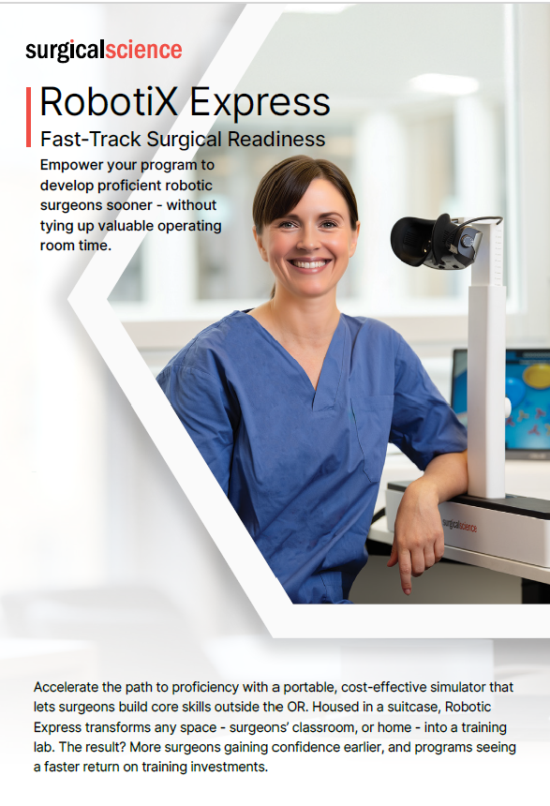
One emerging solution is the use of portable, flexible robotic-assisted surgery simulators. These systems offer a pragmatic solution to accessibility constraints, allow training at any location, helping programs deliver more equitable access and:
- Preparation for certified academic training
- Reinforcement of acquired knowledge
- Manufacturer-agnostics
- 24/7 availability, and surgeon’s schedule adaptability
- Suited for lifelong training
To close the training gap, institutions and training systems should:
- Integrate juniors’ robotics learning earlier in academic curricula
- Ensure equitable access to simulation for all trainees and faculty
- Invest in scalable, multi-unit simulation setups including portable units
Although investment in simulation infrastructure is not trivial, the return includes shortened path to proficiency, sustained competencies and ultimately improved patient safety, and more effective robotic surgery programs.
| Simulation-driven training is essential to safe, effective diffusion of RAS.
Current access barriers and differences in training pathways risk slowing adoption and allowing gaps in competence to continue. An academic, standardized, manufacturer-agnostic approach, robust certification, offers a viable path to align training capacity with the pace of surgical innovation. Following qualifications, surgeons need to participate in continuous lifelong professional development within their home institutions, which can be supported by portable simulation systems with continuous availability. Connected to the cloud, simulators will enable longitudinal monitoring of technical performance, which is essential for certification. |
Talking Points
- What are your experiences with RAS training?
- Do you believe surgeons are reaching proficiency fast enough?
- How early should robotics be introduced into training programs?
- How can we expand simulation access without disrupting clinical operations?
Share the Product Flyer
Download the RobotiX Express product flyer to discover more and share it with your colleagues.