



Skip to content

Request a Free Quote

Do you want to learn more? Feel free to request more information to receive a quote from our Team. Are you ready to purchase a simulator? Fill out this form and someone from our team will be in touch.

HERO Images RobotiX Express Mobile RobEx

Scaling Robotic Surgery
Starts With Readiness.

Expanding the Ecosystem for Safe, Scalable Performance.

Robotic Surgery Is Accelerating.

The global market is projected to reach $19.6B by 2030, with robotic procedures expanding across specialties and healthcare systems are investing heavily in robotic platforms and surgical technology.

Robotic surgery is transforming modern healthcare, with adoption increasing across orthopedics, general surgery, urology, and beyond. Hospitals are rapidly expanding robotic programs to improve clinical outcomes, increase operating room efficiency, and meet growing demand for advanced surgical capabilities across specialties.

As the number of robotic platforms increases, the need for capable and ready surgeons grows alongside them, making frequent practice outside the operating room essential to strengthen skills and build confidence.

Readiness becomes easier to support when access to training extends beyond the operating room and into everyday workflows. Training programs need to evolve at the same pace.

The trajectory is clear: robotic surgery will continue to expand across healthcare systems.

Bridging the Gap

Demand is growing.
Access is limited.
Time is constrained.

READ ARTICLE

10 - 25%
Annual Growth in Robotic Procedures
20 - 50
Cases Needed for Proficiency
OR Time
= One of the Most Expensive Hospital Resources

The Real Challenge

Training plays an important role, but building readiness requires consistent practice over time.

Access, time, and availability often limit how surgeons train. In many programs, training is tied to robotic systems in the operating room, where availability is prioritized for patient care. This restricts practice to limited time windows, often outside regular hours, and makes access dependent on scheduling rather than individual learning needs.

Opportunities for hands-on training are not always available early enough, and access to simulation is often centralized, requiring dedicated facilities, equipment, and coordination. As a result, surgeons compete for limited training time, and progression can be delayed.

Progress is not always easy to follow, and opportunities to repeat key skills can vary.

This creates a training gap. Readiness develops unevenly across surgeons, remains inconsistent across hospitals, and is difficult to track. This directly impacts patient safety and clinical outcomes. When readiness is not clearly defined, variability increases, and with it, risk.

Expanding access to consistent practice helps reduce variation and strengthen performance.

Current reality:

Limited Console Access
OR-dependent Training
Subjective Progression

Consequences:

Inconsistent Performance
Hidden Skills Gaps
OR Used for Training

The Readiness Gap

Healthcare systems scale through standardization, measurement, and predictable performance, not just individual expertise.

Robotic readiness is often assumed rather than defined, and estimated rather than measured, leaving many programs without a consistent, system-wide approach. At the same time, robotic procedures continue to increase, and programs expand into more complex cases. Safe adoption requires not only access to technology, but consistent preparation across surgeons and teams.

This increases pressure on the workforce. Demand for robotic surgeons is rising, while training capacity remains limited and skill requirements continue to evolve. Retirements and burnout further widen the gap.

That is the gap.

Closing this gap requires a more connected approach to how readiness is developed, supported, and followed over time.

Readiness Ecosystem | RobotiX Express

A connected approach to building readiness.

RobotiX Express enables this ecosystem by making readiness easier to develop and track across surgeons and teams.

  • Every user reaches a defined baseline
  • Progression becomes clear
  • Preparation improves before entering the OR.

Training moves beyond isolated sessions into a connected approach that links simulation, performance, and clinical workflows.

Train Anywhere. Build Readiness.

Supporting readiness means creating more opportunities to practice consistently.

A connected approach enables:

  • Continuous access to practice
  • Clear progression over time
  • Better visibility into development

RobotiX Express helps make training more accessible and easier to integrate into everyday workflows.

Built for Surgeons and Programs

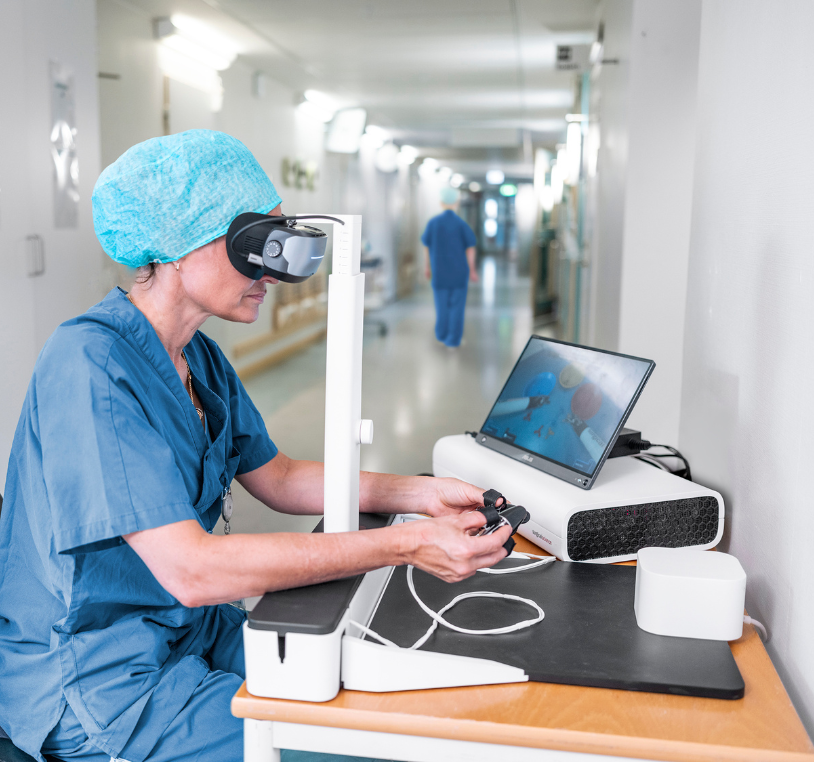
RobotiX Express removes the limitations of traditional surgical simulation by making robotic training portable, continuous, and measurable.

Instead of relying on simulation centers or OR access, surgeons can train anywhere, increasing practice frequency and accelerating skill development. Training is structured around defined proficiency levels, enabling consistent progression across users and sites.

Built-in performance tracking ensures that readiness is objective, consistent, and validated. Simulation-based training has been shown to reduce the learning curve by up to 40%. RobotiX Express builds on this by embedding training directly into the platform.

The result is a scalable model:

More access leads to more practice
Faster readiness
Increased surgical capacity


Not enough surgeons are reaching basic robotics competency, leaving a significant training gap.


Our Solution

1

A Strategic Decision for Robotic Programs

hexagon red

RobotiX Express supports healthcare leaders responsible for robotic surgery programs in expanding their programs alongside the growth of robotic-assisted procedures, while maintaining consistent readiness across surgeons and teams.

As programs grow, complexity increases. More surgeons, more procedures, and greater pressure on operating room time require a more structured approach to training and development.

Consistent readiness creates a clearer path from training to performance. This improves how programs operate, helping reduce variation, make better use of OR time, and support continued growth.

Because readiness impacts risk, efficiency, and program development, it becomes a strategic priority, not just a training decision.
Robotic Surgery Will Scale. The Question Is How Safely.

Without Scalable Robotic Training, Growth Increases Risk

As robotic programs expand, complexity and pressure on healthcare systems increase. Without a connected approach to readiness, variability remains.

With RobotiX Express, readiness becomes measurable, consistent, and scalable across the ecosystem.

Scaling robotic surgery without standardized readiness increases clinical and operational risk. Ensuring readiness is not only an operational priority. It is a patient safety imperative.

For Robotic Program Leaders

  • Executives
  • Program leaders
  • Department heads
  • Training leaders


Standardize Robotic Readiness.  Scale Safely.

Make Robotic Surgery Training Measurable Across Your Entire Program.

Share the Product Flyer

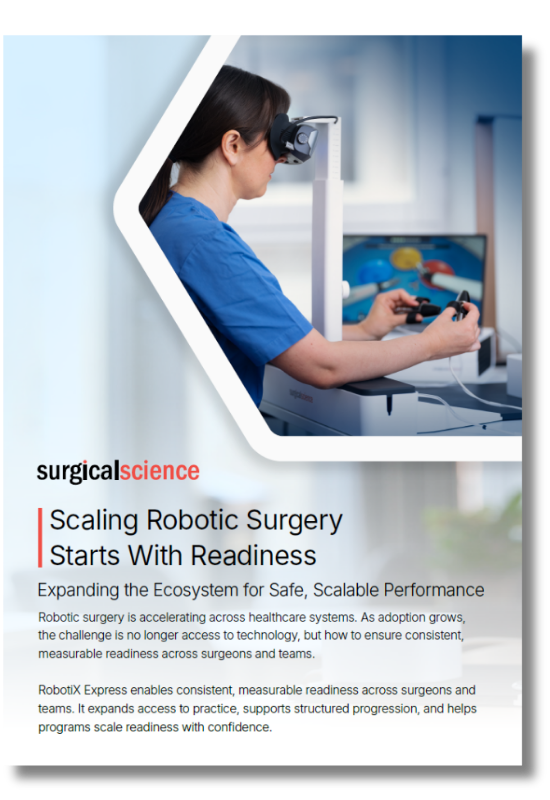
Download the RobotiX Express product flyer to discover more and share it with your colleagues.

RobotiX Express Scaling Robotic Surgery
Skip to navigation